Find your basin area on the In Your Area page. Current project info in your area will be posted on your basin page. You’ll also find links to additional resources.
What is a sanitary sewer overflow?
A sanitary sewer overflow, or SSO, is a discharge of raw sewage that overflows from a sewer onto the ground or into local streams and rivers. SSOs have many different causes, including: clogs, pipes breaking, power failures, undersized infrastructure, rain water entering leaky pipes, inadequate sewer capacity, sewer defects that allow stormwater and groundwater to overload the system, lapses in sewer system operation and maintenance, and vandalism. For more information click here or to report a suspected SSO call (803) 545-3300.
What are the significant problems with the City’s wastewater system?
The wastewater system consists of aging infrastructure that must be replaced, rehabilitated, or upgraded to increase capacity. Having the correct technology, data, and management systems for efficient operation and decision-making is imperative to the future of the system.
What causes inadequate pipes?
Because the much older sewer system was constructed from clay pipes, these pipes tend to show their age by the way of cracks, which makes them susceptible to wet-weather events. As this infrastructure ages, the need to assess the system and replace or rehabilitate infrastructure increases.
Does stormwater and wastewater flow through the same pipes?
The stormwater drainage system is a separate system and is not a part of the wastewater collection system. For more about the City’s stormwater system click here. To learn how our lawncare practices impact local waterways via the storm drain, visit columbiascwater.net/about-stormwater/blue-thumb-landscaper/.
What is a private sewer line? Does the City repair private sewer lines?
Your private sewer line is the underground sewer pipe that connects your plumbing to the public sewer system. No, the City does not repair private sewer lines. Property owners are responsible for maintaining and repairing sewer pipes in their buildings and within their property lines. Visit the Columbia Water Customer Library to download the Understanding Your Sewer Lateral brochure.
What is the best way to maintain private sewer lines?
Help keep your private sewer lines in good working condition by avoiding planting trees, shrubs, or bushes in easements on your property and near the sewer lines. Roots from plants and trees can enter, block, and even cause damage to sewers. To download a copy of the Utility Easements: Your Property & City Infrastructure brochure click here.
What is the Clean Water Act?
The Clean Water Act (CWA) establishes the basic structure for regulating discharges of pollutants into the waters of the United States and regulating quality standards for surface waters. The basis of the CWA was enacted in 1948 and was called the Federal Water Pollution Control Act, but the Act was significantly reorganized and expanded in 1972. The CWA has implemented pollution control programs and made it unlawful to discharge any pollutant from a point source (a discharge pipe) into streams, creeks, rivers or lakes unless a permit was obtained.
How old is Columbia’s wastewater treatment facility?
Columbia’s wastewater treatment facility was first constructed in 1974 with a capacity of 20 MGD, which included plans for growth. Subsequent expansions to the plant occurred in 1979, 1983, and again in 1996. The treatment plant is now capable of treating up to 60 MGD.
What is wastewater?
Simply put, wastewater is our used water. We bathe in it, wash our food with it, flush it, clean our clothes in it, and the dishwasher does its thing with it. And all that stuff our water touches – food, soaps, chemicals, human waste – turns our water into wastewater.
Why do we treat wastewater?
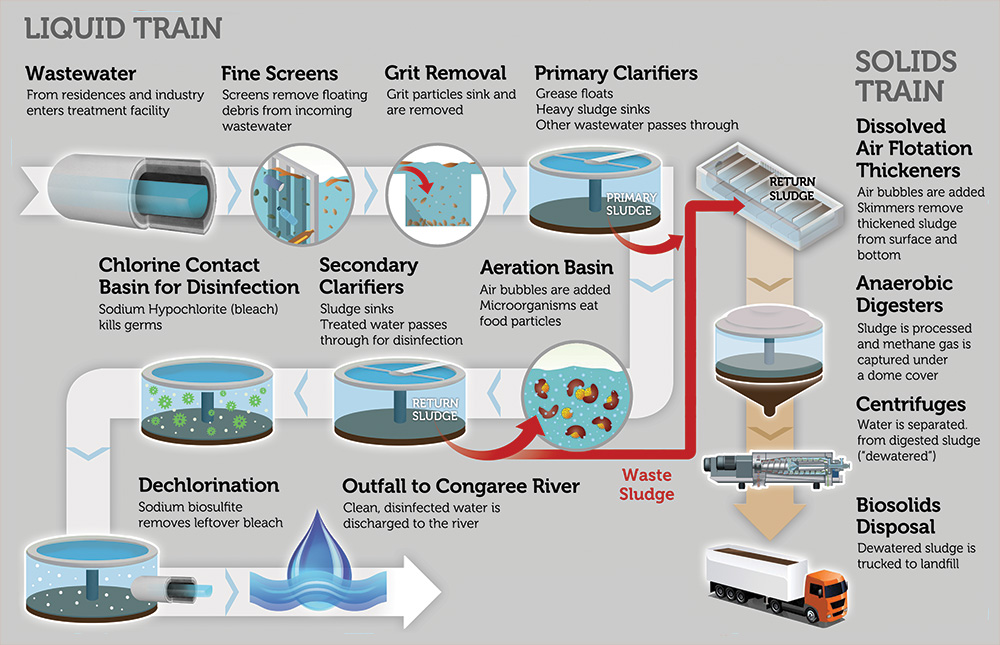
Wastewater (and all that stuff we put in it…) can carry harmful bacteria and chemicals that can contaminate the environment if we don’t treat it properly before releasing it back into nature. Wastewater treatment reduces harmful pollutants and protects our health as well as the natural environment.
Where is my wastewater being treated?
If you’re a Columbia Water sewer customer in Richland and Lexington counties, including Fort Jackson and major portions of West Columbia, your wastewater is treated at the Columbia Water’s Metropolitan Wastewater Treatment Plant (WWTP), located at 1200 Simmon Tree Lane. The plant collects wastewater from approximately 63,000 approved connections and over 1,100 miles of pipe across the City’s sewer system.
What is anaerobic digestion?
Columbia Water’s Wastewater Treatment Plant uses anaerobic digestion as a treatment process to stabilize waste solids and produce methane-rich biogas for beneficial uses. This process takes place in large, covered tanks in the absence of oxygen. Concentrated solids produced during the treatment process are fed to these tanks as food for anaerobic microorganisms which stabilize the solids and produce beneficial biogas. After digestion is complete, the stabilized residual biosolids contain nutrients and organic matter which also provide opportunities for beneficial uses.
What happens in the aeration basin? (Or, got microorganisms? We do!)
After heavy solids are removed from our wastewater, the liquid flows to aeration basins. These basins provide an aerobic treatment environment that requires added oxygen to work properly. Aerobic microorganisms present in the liquid mixture in these basins use the materials from our waste stream as food to grow and multiply. This is known as the Activated Sludge Process. To manage wastewater treatment, the growing population of microorganisms in the basin is balanced with the amount of available food. This balance of microorganisms and food is maintained by removing a portion of the microorganisms that are grown everyday (harvesting) and sending them to the Anaerobic Digesters for further stabilization. A microorganism farming operation!
How does Columbia Water capture and reuse natural gas?
At the Columbia Water Wastewater Treatment Plant biogas/methane is produced and captured in digesters during a process called anaerobic digestion. Moisture and impurities are scrubbed from the biogas and it is used in place of natural gas to heat the digesters year-round for optimum digestion performance. Excess biogas is currently flared rather than being released to the atmosphere. Our staff are currently considering alternative uses of the excess biogas rather than flaring. Potential alternative uses may include selling conditioned biogas to the natural gas supplier and alternative uses in biogas-fired engines.
What are pump stations and why do we need them?
Pump stations, also called lift stations, have a pump or set of pumps that lift wastewater to a higher elevation before moving it to the treatment plant. Columbia Water operates and maintains 50 pump stations that allow wastewater to flow smoothly over a significant distance. Our pump stations ensure that this wastewater is managed efficiently to minimize environmental impacts and health risks to the community.